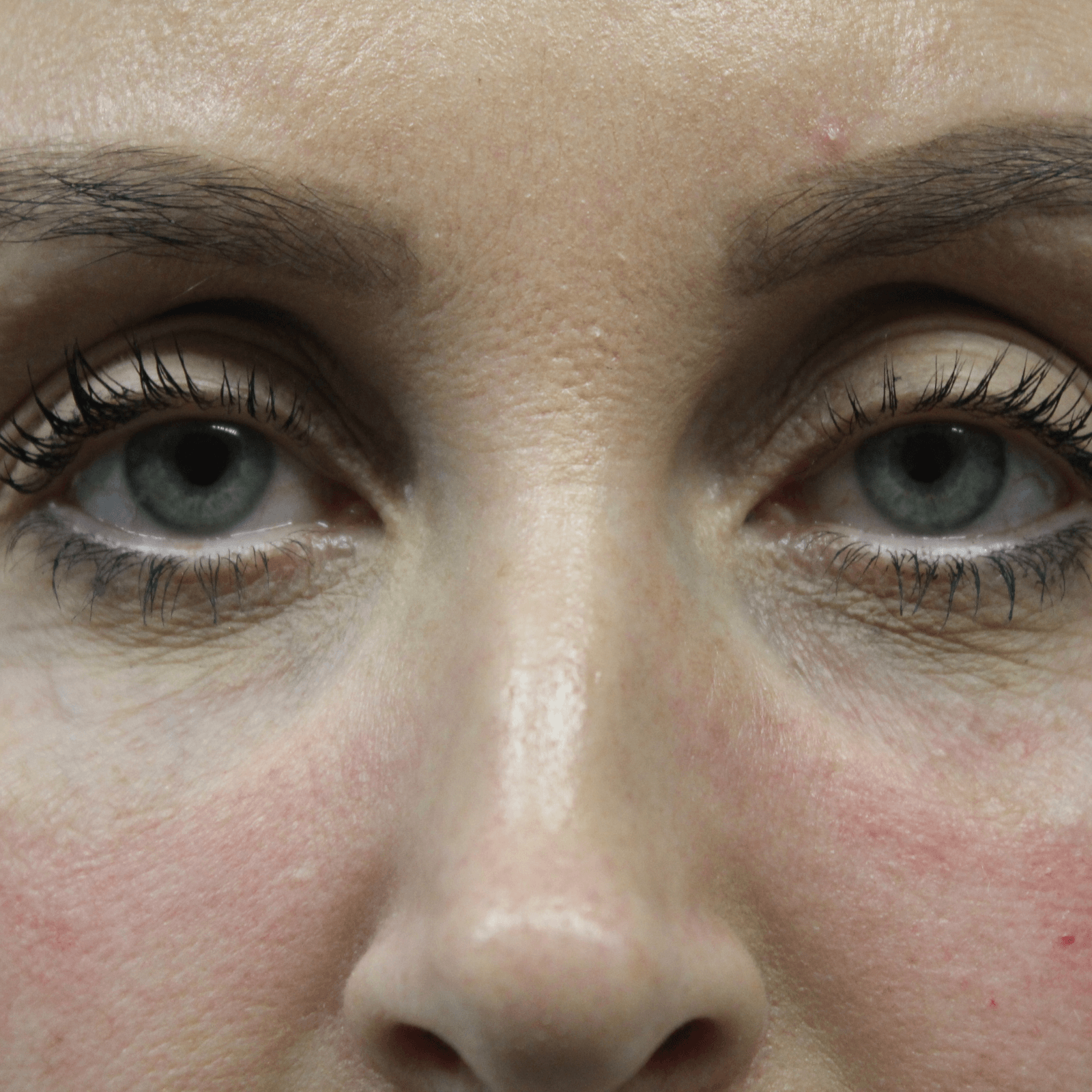
Quick answer: Concealer covers dark circles at the surface. Tear trough filler addresses the underlying cause when the concern is volume loss or hollowing beneath the eye. Tear trough filler in Belfast at Array Aesthetics is a medical treatment using hyaluronic acid to gently restore volume beneath the eyes, delivered within a doctor-led, RQIA-regulated clinic.
If you are applying more and more concealer but your under-eyes still look tired, the problem may not be your makeup. For many patients, the shadow beneath the eye is caused by volume loss rather than pigmentation. In those cases, tear trough filler treatment addresses the underlying hollow rather than simply covering it. Many patients who search for tear trough filler near me are actually trying to answer a different question first: are their dark circles caused by pigmentation, or are they the result of volume loss beneath the eye? Understanding the difference is the first step in choosing the right treatment.
The under-eye is more complex than it looks
The area beneath the eye is one of the most anatomically layered zones on the face. The skin is thinner here than almost anywhere else; the blood vessels sit closer to the surface, and the tear trough itself is a ligamentous attachment that anchors the skin down to the underlying bone. As the face ages, the cheek fat pad descends; the tear trough ligament stays fixed in place, and a small hollow forms in the transition between eyelid and cheek. That hollow rarely develops in isolation. It usually sits within a wider pattern of facial volume loss across the midface, which is why the cheek is assessed alongside the under-eye at consultation.That hollow is what most patients recognise as tired or shadowed under-eyes, whether or not any actual dark pigment is present.
Concealer can only address one of these factors. Under-eye filler addresses a different problem entirely by restoring lost volume beneath the eye. Understanding which is dominant in your face is the difference between a treatment that works and one that disappoints.
What concealer can do, and where it stops
Concealer is designed for surface correction. Its job is to disguise the appearance of pigmentation, redness, or the shadow cast by an under-eye hollow. Used well, it evens the tone, brightens the eye area, and gives the impression of a rested face. It is quick, non-invasive, and adjustable in a way no injectable treatment can match.
Its limitation is structural. A concealer cannot fill a hollow, and when a true volume deficit has developed at the tear trough, applying pigment on top of it often makes the shadow worse rather than better. The product settles into the depression, catches light differently, and by mid-afternoon can start to crease along the exact groove it was meant to disguise. Patients who describe their concealer as looking heavier the more they wear are usually not describing a pigment issue at all. They are describing a hollow that pigment cannot solve.
Tear trough filler works on the other side of the problem
Where concealer sits above the skin, tear trough filler works beneath it. A small, precise volume of hyaluronic acid under-eye filler is placed into the deep tissue of the tear trough, gently rebuilding the support that has been lost, lifting the depression, and softening the transition between the lower eyelid and the cheek. Because the shadow was being cast by the hollow, restoring the underlying volume removes the shadow that concealer was trying to cover.
The product used matters as much as the technique. At Array Aesthetics, a soft, low-cohesivity hyaluronic acid formulation is selected for its suitability in the delicate under-eye tissues, allowing smooth integration and helping the injector achieve a natural-looking result. Injection is performed by an experienced medical injector, on a bone-deep plane where possible, and always as part of a considered assessment of the whole periorbital region. This is the standard of under-eye filler Belfast patients should expect from a doctor-led setting.
Reading the anatomy correctly
Patients seeking dark circles treatment in Belfast often fall into three distinct categories, and the under-eye is one of the few areas of the face where treating the wrong category can worsen the appearance rather than improve it. Tear trough filler is usually the right choice when the concern is a genuine hollow, when the shadow deepens visibly in certain lighting or when the patient tilts their head, and when the skin quality of the under-eye is otherwise reasonable. In these patients, concealer becomes less necessary once the underlying volume has been restored.
Array Aesthetics is a doctor-led, RQIA-regulated clinic and a three-time winner of Best Clinic Ireland and Northern Ireland at the Aesthetics Awards (2023, 2024, 2026). The recognition matters here because of what it reflects: a clinical culture built around careful patient selection in an area with narrow margins for error.
Who is not a good candidate for tear trough filler
Not every under-eye concern is suited to filler, and one of the most important parts of the consultation is naming the cases where it is not the right answer. Tear trough treatment is generally not the correct pathway when the primary concern is true dark pigmentation, hereditary or otherwise. It is also not appropriate where the skin is so thin that the underlying vessels show through as a blue-purple tint, where there is significant fluid retention, where prominent under-eye fat pads are creating a puffy appearance rather than a hollow one, or where there is meaningful skin laxity in the lower eyelid.
In those situations, the clinician may recommend polynucleotides to improve skin quality, prescription-grade skincare, oculoplastic assessment for suitability for blepharoplasty, or a combination of these. This is consistent with Array's treatment approach, where surgery or a non-filler alternative is recommended when appropriate rather than filling an area that will not benefit from it.
What the treatment involves
A tear trough consultation at Array Aesthetics begins with an assessment of the under-eye anatomy, the midface, and the skin quality across the periorbital area. The injector considers the tear trough shape, the position of the cheek fat pad, and the character of the shadow the patient is describing. Not every patient who enquires about tear trough filler leaves with a plan for tear trough filler, and that is by design.
If treatment is appropriate, the procedure takes around 20 to 30 minutes. Numbing cream is applied first. Small volumes of filler are placed carefully using a cannula or fine needle, depending on the anatomy. Most patients see an immediate improvement, with the final result settling over two to three weeks as any minor swelling resolves. Before-and-after results vary depending on each patient's anatomy and the severity of the hollow being treated. Published clinical outcomes for hyaluronic acid tear trough treatment support high patient satisfaction rates when appropriate candidates are selected.
Understanding the risks
The under-eye is a highly vascular, technically demanding area, and the risk profile of tear trough filler reflects that. Common side effects include mild swelling, occasional bruising, and short-lived tenderness at the injection site. These resolve within one to two weeks.
The more clinically significant risks are less common but important to name. Product placed too superficially can create a bluish tint through the thin under-eye skin, known as the Tyndall effect. Placement in the wrong plane can produce persistent puffiness or fluid retention. In rare cases, vascular occlusion can occur if filler compromises a facial vessel, and the periorbital area carries specific risks in this respect. Every one of these considerations is reduced by choosing an injector with the anatomical training and clinical judgement to work safely in this region, and by treatment being delivered in an RQIA-regulated medical setting where complications, if they arise, can be managed appropriately.
Aftercare that protects the result
The first 24 to 48 hours after tear trough filler treatment matter. Patients are advised to keep the head slightly elevated when sleeping on the first night, to avoid strenuous exercise, hot yoga, saunas, and alcohol for 48 hours, and to avoid touching or pressing the treated area. Makeup can generally be reapplied at 24 hours where needed, though many patients notice that the concealer they usually reach for is no longer required in the same way.
Common myths about under-eye filler
Tear trough filler can erase dark circles. Not always. Filler resolves the shadow cast by an under-eye hollow, but it has no effect on true pigmentation or on the blue-purple cast of vessels showing through thin skin. Knowing which is present is what makes the difference between a treatment that works and one that disappoints.
The result will look immediate and perfect. Immediate improvement is common, but a settled result develops over two to three weeks. Mild asymmetry or slight fullness in the first week is normal and rarely the final picture.
Tear trough filler is a routine procedure. It is a specialist procedure delivered in an area with narrow margins for error. The clinical setting and injector experience carry more weight here than in almost any other injectable treatment.
How to know if you're ready
Patients who benefit most from a tear trough consultation often recognise themselves in several of the following:
You always look tired despite sleeping well.
The shadow beneath your eye changes noticeably depending on the lighting.
Concealer settles into a groove or looks heavier the longer you wear it.
Your cheeks have become flatter with age, and the under-eye shadow has become more visible as a result.
You are bothered more by hollowness than by puffiness.
If most of those apply, tear trough treatment may be worth exploring. If the concern is more about surface pigmentation or general skin quality, a skincare and polynucleotides pathway is often the honest starting point.
Booking a Tear Trough Filler Consultation in Belfast
If you have been searching for tear trough filler near me, arranging a consultation with an experienced medical injector is the safest way to determine whether tear trough filler is appropriate or whether another treatment would produce a better result. Tear trough consultations at Array Aesthetics are carried out by medically trained injectors within a doctor-led, RQIA-regulated Belfast clinic, where careful patient selection and full facial assessment are central to achieving safe, natural-looking results. Appointments are arranged through the Pabau booking system on the Array Aesthetics website, or by calling the Belfast clinic on 028 9457 1840.
Frequently asked questions
How much does tear trough filler cost in Belfast?
Tear trough filler at Array Aesthetics is £400 per session. Full pricing is published openly on the Array Aesthetics website.
How long does tear trough filler last?
Most patients see tear trough filler last between nine and eighteen months. The under-eye area tends to hold filler longer than more mobile areas of the face because there is relatively little muscle movement in the region.
Does tear trough filler hurt?
Discomfort is generally mild. Numbing cream is applied before treatment, and the filler itself contains lidocaine. Most patients report a brief pinch at the injection point rather than sustained pain.
Can tear trough filler be dissolved if I do not like the result?
Yes. Hyaluronic acid tear trough filler can be dissolved using an enzyme called hyaluronidase. In the under-eye area, ultrasound-guided dissolving is often recommended for precision.
Is under-eye filler the same as tear trough filler?
In most cases, yes. Under-eye filler is the general term patients use, while tear trough filler refers specifically to treating the hollow beneath the eye using hyaluronic acid. In clinical practice, the two are typically the same treatment.
Will people notice I have had tear trough filler?
A well-delivered result should read as a rested version of you, rather than an obvious treatment. Most patients report friends and family commenting that they look well or well-slept, without identifying why.